Order custom trading cards by counting recipients first, then cards per recipient, trade and giveaway cards, and a small reserve for latecomers and replacements. Get Custom Trading Cards prints runs from a minimum of 12, so you can match the quantity to your real roster instead of guessing. This guide walks through the math for teams, schools, businesses and game projects.
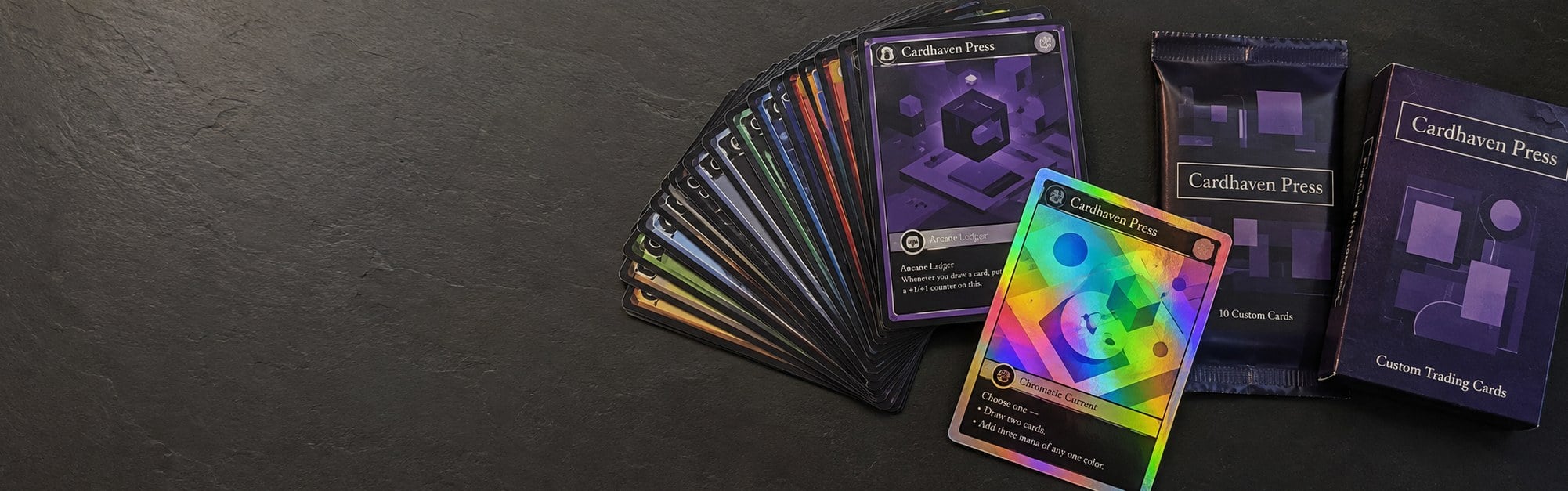
- Count recipients first, then cards per recipient, trade cards and a reserve
- Plan quantities per design, not one flat number for the whole set
- Keep chase and foil cards deliberately limited
- Minimum order is 12 cards with a free mockup within 24 hours
- Standard turnaround is about 2 weeks after approval
How many custom trading cards should I order for my set?
Order enough custom trading cards to cover every person who will receive a full set, every card you plan to trade or give away, plus a small reserve for spares and late additions. Start from people, not from cards: count recipients first, decide how many cards each recipient gets, then add your reserve. Get Custom Trading Cards prints runs from a minimum of 12 cards, so even a small club or a single classroom can order exactly what it needs.
The mistake most first-time buyers make is picking a round quantity that feels right and working backward. That approach leaves you short on the cards people actually want and long on the ones nobody asks for. A trading card set behaves differently from a stack of business cards because each design in the set has its own audience. A player card is wanted by that player, their family and their teammates. A coach card or a logo card may only be wanted once per set.
Write your plan as a simple worksheet before you request a quote: list every design in the set, who receives it, how many copies each person gets, and what you want held back. That worksheet becomes your quantity, and it also makes the quote faster and more accurate.
What is the simplest way to calculate a trading card quantity?
The simplest way to calculate a custom trading card quantity is a four-step count: recipients, cards per recipient, trade and giveaway cards, then a reserve. Multiply the first two, add the third, and add a modest reserve on top. Doing the math in that order keeps the reserve proportional to the real run instead of guessed.
- Count recipients. Players, students, employees, customers or attendees who each receive their own set or card.
- Decide cards per recipient. A player often wants several copies of their own card to hand out, while a fan or customer may receive a single card or a full pack.
- Add trade and giveaway cards. Cards meant for swapping at tournaments, events or trade days need their own line in the plan.
- Add a reserve. Keep a small batch for latecomers, damaged cards, replacements and the archive copy you will want later.
If your set mixes designs, run the count design by design. A team set with individual player cards, a team photo card and a sponsor card will rarely need the same quantity of each design, and treating them identically is where most waste comes from.
Should every card design in a set be ordered in the same quantity?
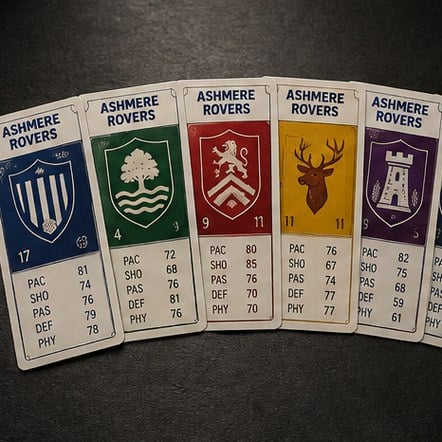
Every card design in a custom trading card set does not need the same quantity, and ordering them equally usually wastes money and space. Plan quantities per design based on who wants that specific card. Player and character cards tend to need the most copies, while header, checklist and logo cards need fewer.
| Card type | Who wants it | Quantity approach |
|---|---|---|
| Individual player or character cards | The subject, family, teammates, fans | Highest per-design quantity; scale with how widely the subject trades |
| Team, group or cover cards | Everyone who receives a set | One per complete set plus a reserve |
| Sponsor or business cards | The sponsor, plus set recipients | One per set plus extras for the sponsor to display or hand out |
| Chase, foil or holographic cards | Collectors and top performers | Deliberately limited; scarcity is the point |
| Checklist or header cards | Set collectors | One per complete set |
Chase cards deserve special care. If you add foil or holographic trading cards to a set, keep their quantity intentionally low so they stay special. Printing too many removes the excitement that made you add them in the first place.
How do sports teams and leagues plan trading card quantities?
Sports teams and leagues plan custom trading card quantities per player, because each player card has its own small market of family members, friends and teammates. Ask families early how many copies of their player’s card they want, then build the team card and any coach or sponsor cards around the total number of sets.
For a league, plan team by team rather than league-wide. Rosters differ in size, and some teams trade cards heavily at tournaments while others treat them as keepsakes. A short survey before the order, collected by each team parent or coach, gives you real numbers instead of assumptions.
- Hold a reserve of each player card for mid-season roster additions and lost cards.
- Plan tournament trade cards separately from keepsake sets, since trade cards leave the team.
- Confirm name spellings and jersey numbers per card before approving the mockup.
The sports trading cards page at Get Custom Trading Cards covers layouts and finishes that suit youth, club and school teams, and the same quantity worksheet works for every sport.
How should a classroom or school plan how many trading cards to order?
A classroom or school should plan custom trading card quantities per student, with a reserve for new enrollments and absences on picture day. Count the class roster, decide whether each student gets only their own card or a full class set, and add cards for teachers and staff if they appear in the set.
The difference between those two models is large. If each student receives just their own card, the quantity roughly equals the roster. If each student receives a full class set, every card design is multiplied by the class size, and the total grows quickly. Decide which model you want before you request a quote.
Schools also benefit from staging. Order the core class set first, then add a second smaller run for mid-year arrivals rather than guessing at enrollment changes months ahead. The custom trading cards for schools page explains how teachers and booster clubs use cards for rewards, reading goals and keepsakes, which affects how many each student should receive.
How many trading cards does a business, event or game project need?
A business, event or game project needs custom trading cards in quantities tied to how the cards are distributed: handed out by staff, packed into kits, or sold and traded. Each distribution method changes the math, so name the method before you name the number.
Business and employee cards. Count employees featured, then decide how many copies each person needs for clients, trade shows and internal recognition. Sales teams often go through more cards than office staff. See business and team trading cards for common formats.
Event and giveaway cards. Base the quantity on expected attendance and how many cards each guest receives. Hand-out events usually end with leftovers, so a modest reserve is enough.
Game and TCG projects. A game deck needs a fixed card count per deck, multiplied by the number of decks you plan to build, playtest or sell. If cards are packaged, the card packs and boxes page shows how pack contents affect totals. For early prototypes, keep the run small and save larger quantities for the version that has passed playtesting.
When does it make sense to split one order into a first run and a reorder?
Splitting a custom trading card order into a first run and a reorder makes sense whenever the final quantity is uncertain, a roster may change, or you want to test how people respond before committing. Get Custom Trading Cards keeps your approved artwork, so a reorder starts from a design that has already been proofed.
Staging works especially well in these situations:
- Season-long teams where players join or leave after the first games.
- Game designers who want feedback on art, wording and balance before a larger run.
- Businesses testing whether clients and prospects actually keep the cards.
- Schools expecting new students partway through the year.
Staging has a trade-off: two smaller runs usually cost more per card than one combined run, and the second run adds another production window of about 2 weeks. If your event date is fixed and your numbers are firm, one order is simpler. If the numbers are moving, a confident first run plus a planned reorder beats a large guess.
What should I send with my quote request so the quantity is right?
Send a design-by-design quantity list with your custom trading card quote request, along with your deadline, size, stock and finish preferences. A clear list lets Get Custom Trading Cards return an accurate quote and a free mockup within 24 hours, and you pay nothing until you approve the design.
- The number of different designs in the set.
- How many copies of each design you need.
- Whether any cards are foil, holographic or otherwise special.
- Whether cards ship loose, in packs or in boxes.
- The date the cards must be in hand.
Standard turnaround is about 2 weeks after approval, with faster turnaround available through express shipping. Revisions to the mockup are unlimited and free, so use that step to confirm names, numbers and quantities line by line. When the list is ready, submit it through the custom quote form, or review how it works first.
Frequently asked questions
How do I estimate trading card quantities when my roster is not final?
Custom trading cards can be ordered for the confirmed roster first, with a planned reorder for players or students who join later. Get Custom Trading Cards keeps your approved artwork, so the second run reuses a proofed design. If your deadline is fixed, add a modest reserve of blank-name spares or extra team cards to the first order instead of waiting on final numbers.
How many spare trading cards should I keep in reserve?
Spare custom trading cards should cover latecomers, damaged cards, replacements and at least one archive copy of every design. Keep the reserve modest and proportional to each design rather than adding the same extra amount everywhere. Player cards that trade heavily need more spares than checklist or cover cards, which usually only need one extra per set.
Do players usually want more copies of their own trading card?
Players often want several copies of their own custom trading card to give to family, friends and teammates. Ask each family or player for a number before you order instead of assuming. Get Custom Trading Cards can print different quantities for different player cards in the same set, so popular cards are not limited by quieter ones.
Is it cheaper to order one large run of trading cards or several small ones?
One combined run of custom trading cards usually costs less per card than several small runs, because setup happens once. Several small runs give you flexibility when numbers are uncertain. Get Custom Trading Cards quotes both approaches, so you can compare a single order with a staged first run and reorder before deciding, without committing to anything up front.
Should chase or foil cards be ordered in smaller quantities than base cards?
Chase and foil custom trading cards are usually ordered in deliberately smaller quantities than base cards, because scarcity is what makes them exciting. If every recipient gets a holographic card, the card stops feeling rare. Decide which designs are special, keep those runs intentionally limited, and list the quantity of each one separately on your quote request.
How do I plan trading card quantities for a tournament trade day?
Tournament trade custom trading cards should be planned separately from keepsake sets, since trade cards leave the team and rarely come back. Estimate how many teams attend and how actively players swap, then give each player a trade stack. Keep keepsake sets for players and families in a separate count so trading never empties the set people want to keep.
Can I mix different quantities of each design in one trading card order?
Mixed quantities per design are normal for custom trading card orders at Get Custom Trading Cards. A set can include many copies of popular player cards, fewer team or sponsor cards, and a limited number of chase cards. List each design with its own quantity on the quote request so the mockup and quote reflect the real plan.
How should a game designer plan trading card quantities for playtesting?
Game designers should plan custom trading card quantities for playtesting around the number of complete decks testers need, not a large print run. Multiply the cards per deck by the number of testing groups, then add a few spare decks. Save larger quantities for the version that has passed playtesting, since rules and art often change after early feedback.
What happens if I run out of trading cards after my event?
Running out of custom trading cards after an event is solved with a reorder from your approved artwork. Get Custom Trading Cards keeps the proofed design on file, so you can request more copies of only the designs you need. Standard turnaround is about 2 weeks after approval, with faster turnaround available through express shipping when timing is tight.
Should every employee in a business trading card set get the same number of cards?
Employees featured in a business custom trading card set rarely need the same number of cards. Client-facing staff and sales teams hand out more cards at meetings and trade shows, while office staff may want a few keepsakes. Ask each department how cards will be used, then set quantities per person instead of one flat number for everyone.
How do I count trading cards when they ship in packs or boxes?
Packed custom trading cards are counted by multiplying cards per pack by the number of packs, then adding any loose spares. Decide the pack contents first, including which designs and how many chase cards go in each pack. Get Custom Trading Cards can quote cards together with packs and boxes, so the packaging count and card count match exactly.
Get a free mockup for your trading cards
Send your logo or idea and the quantity you have in mind. Get Custom Trading Cards returns a free mockup within 24 hours, you approve the design before anything is produced, and standard turnaround is about two weeks with faster options available. Get a custom quote.