Size is the first spec you commit to on a custom card project, and it quietly settles a dozen decisions that come after it. It decides which sleeves and deck boxes your customers can buy, how the cards feel in an adult or a child’s hand, how many cards fit on a press sheet, and therefore what the run costs. Choosing it well is mostly a matter of knowing the five formats the industry actually supports and matching one to how the cards get used. Here is how the standard sizes compare and when each is the right call.
Poker, the default for a reason
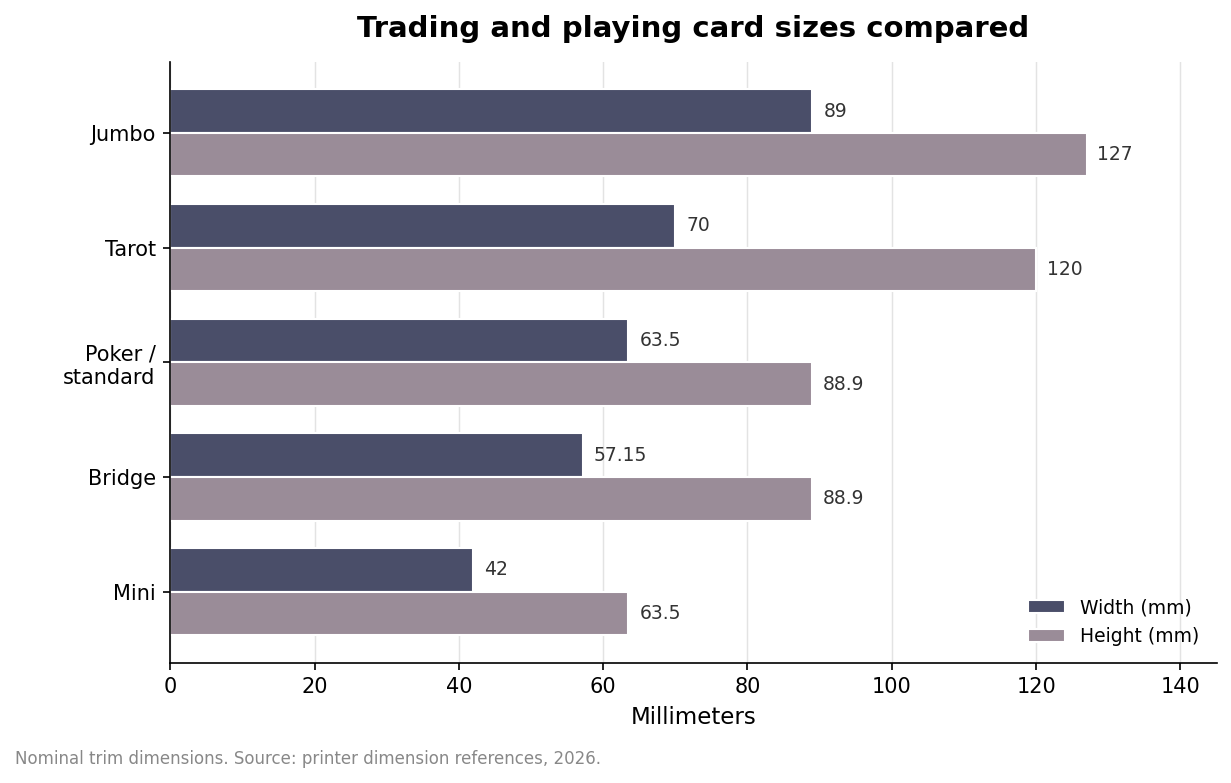
The poker or standard size measures 2.5 by 3.5 inches, which is 63.5 by 88.9 millimeters, and it is the global default for custom trading cards. Magic: The Gathering, Pokemon, most sports cards, and the overwhelming majority of custom games use it. The practical advantage is not the dimensions themselves but the ecosystem around them: sleeves, top-loaders, binder pages, and deck boxes are all built for this size and sold everywhere, so your customers can protect and store the cards without hunting for specialty accessories. Unless you have a specific reason to deviate, this is the size to design for, and it is the one that will cost the least because presses and finishing lines are set up around it.
The ecosystem cuts finer than most first-time publishers expect. Poker-size sleeves come in graded fits, from loose penny sleeves to snug perfect-fit inner sleeves that players double up for tournament play, and all of them are cut to the 63.5 by 88.9 millimeter card. Design at exactly that trim and your cards drop into any of them. Drift even a millimeter or two, as sometimes happens when a designer scales a bridge layout up without re-checking, and cards bind or rattle in commercial sleeves, which is the kind of complaint that follows a product around in reviews.
Bridge, when a narrower card helps
The bridge size keeps the 3.5-inch height but narrows the width to 2.25 inches, roughly 57 by 89 millimeters. That quarter inch matters when players hold a large hand of cards, which is exactly why traditional bridge and canasta decks adopted it and why some modern hand-heavy games choose it. The narrower footprint lets small hands fan more cards comfortably. The tradeoff is accessory availability: bridge-size sleeves exist but are less common than poker, so if your game leans on frequent sleeving, weigh that friction before you commit.
Tarot and oversized, when the art leads
The tarot size, about 2.75 by 4.75 inches or 70 by 120 millimeters, exists because some cards are meant to be looked at rather than shuffled quickly. Tarot and oracle decks use it, and so do card-based products where full-bleed artwork or a lot of printed text needs room to breathe. The larger surface is a gift to a designer and a constraint to a player, since oversized cards are harder to shuffle and need their own sleeves. Choose it when the card is a canvas first and a game piece second.
Mini and jumbo, the two ends of the range
At the small end, the mini format runs about 1.65 by 2.5 inches, roughly 42 by 63.5 millimeters. It is rarely a game’s main deck and usually shows up as board game components, tokens, resource cards, or promotional inserts where table space is tight and the card carries little text. At the large end, the jumbo index size of about 3.5 by 5 inches, near 89 by 127 millimeters, is built for visibility: display pieces, oversized promotional cards, teaching decks, and children’s games where big indices and easy handling beat portability. Neither is a general-purpose choice, but each solves a specific problem cleanly.
What “standard” means, and the sizes people confuse
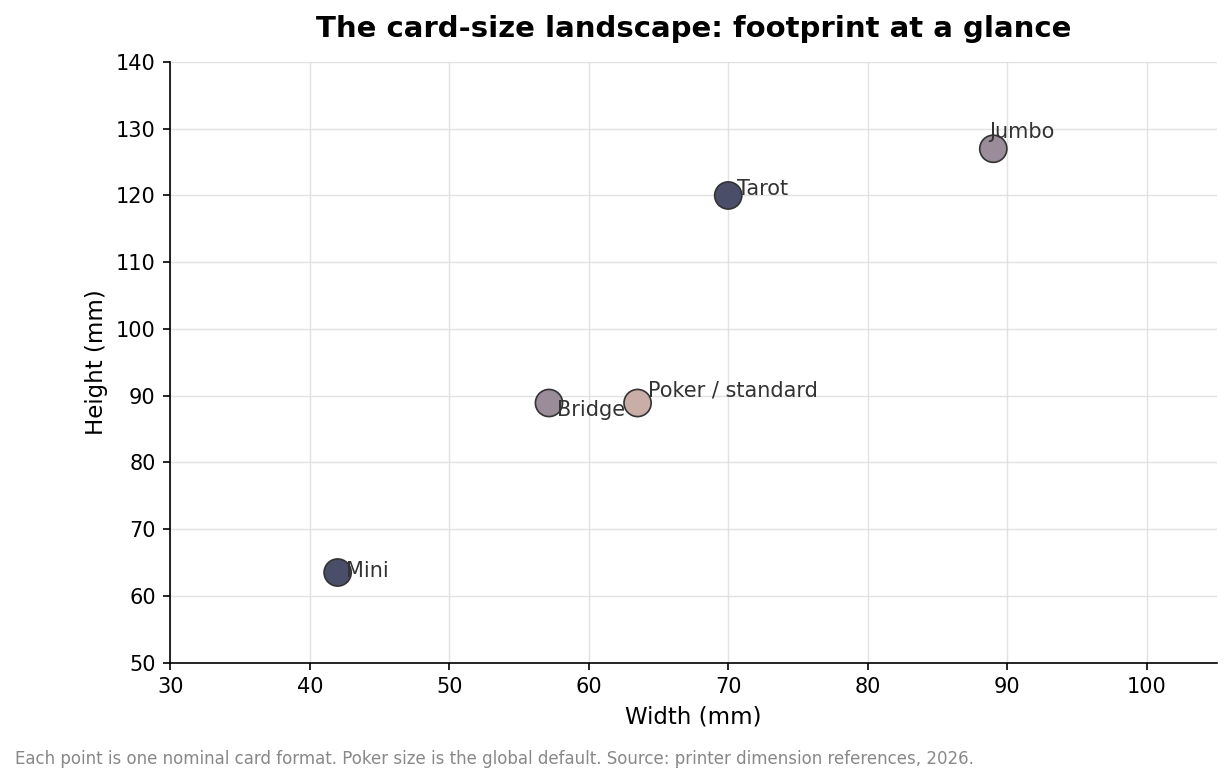
A recurring source of confusion is the phrase “standard size,” which people use to mean different things. When a game publisher or printer says standard trading card game size, they almost always mean poker, 63.5 by 88.9 millimeters, the same footprint as the major TCGs. When a traditional card maker says standard, they may mean either poker or bridge depending on their heritage market, since bridge was the classic size in parts of Europe. The safe habit is never to order by name alone. Confirm the millimeter dimensions on the quote, because “standard” without numbers is where mismatched sleeves and surprise reprints begin. It is also worth knowing that a handful of specialty formats exist beyond these five, including square cards and custom die-cut shapes, but those carry their own tooling and accessory limits and are a deliberate choice rather than a default.
How size interacts with stock, sleeves, and cost
Once size is set, the rest of the spec falls into place around it. Standard card stock lands around 300 to 310 gsm, roughly 12 point, which gives the familiar snap and shuffle feel at any of these sizes; you can go heavier for a premium hand or lighter for disposable promo cards. Corner radius is typically about 3 to 3.5 millimeters, and matching it to commercial sleeves matters most at poker size. Larger cards consume more material and fit fewer to a press sheet, so a tarot or jumbo run costs more per card than the same quantity of poker cards, and mini cards are not automatically cheaper because handling and finishing do not shrink proportionally. Lock the size before you build artwork, because bleed, safe zones, and layout all reference the trim dimensions, and resizing a finished design across formats rarely survives without cropping something you wanted to keep.
Match the format to the use, poker for almost everything, bridge for full hands, tarot for art, mini for components, jumbo for display, and every downstream decision from sleeves to cost gets easier. Guess the size and you inherit accessory headaches and reprints that a five-minute comparison would have prevented.